Preparing for French language proficiency exams such as TEF Canada and TCF Canada requires more than simply learning grammar and vocabulary. These exams test a candidate’s ability to use French effectively under time pressure in real-life communication situations. One of the most effective ways to prepare successfully is through regular mock tests.
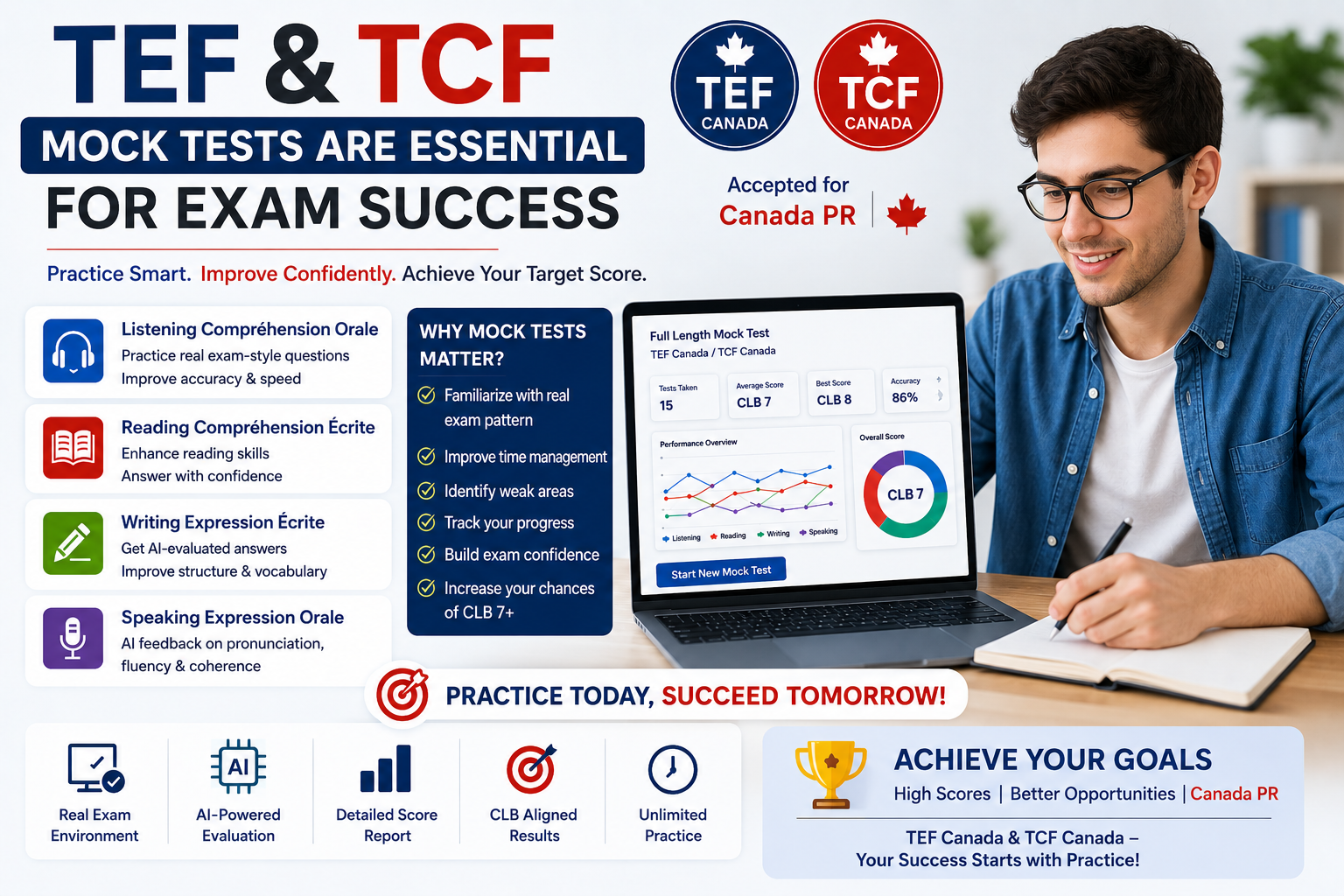
TEF and TCF mock tests help students understand the exam format, improve time management, identify weaknesses, and build confidence before the actual examination day. Whether students are preparing for immigration, higher education, or professional opportunities, mock exams play a major role in improving overall performance.
At LearnFLE, students receive structured mock test practice and personalized guidance to strengthen all four language skills needed for TEF and TCF success.
Understanding TEF and TCF Exams
The TEF (Test d’Évaluation de Français) and TCF (Test de Connaissance du Français) are internationally recognized French proficiency exams used for:
- Canadian immigration
- Permanent residency applications
- French citizenship
- University admissions
- Professional certifications
Both exams evaluate four major language skills:
- Listening comprehension
- Reading comprehension
- Writing expression
- Oral expression
The exams are designed to measure real communication abilities, not just theoretical language knowledge.
According to France Éducation International, these tests are aligned with the Common European Framework of Reference for Languages (CEFR), which evaluates language proficiency from beginner to advanced levels.
Because the exams are highly structured and time-sensitive, mock tests become essential preparation tools.
Familiarity with Exam Format
One of the biggest reasons mock tests are important is that they help students become familiar with the actual exam structure.
Many candidates struggle during the real exam simply because they are unfamiliar with:
- Question patterns
- Timing requirements
- Audio speed
- Task instructions
- Response formats
Mock exams simulate real test conditions and help students understand exactly what to expect.
Research on language testing preparation suggests that exam familiarity reduces uncertainty and improves student confidence during standardized language assessments. (cambridge.org)
When students repeatedly practice with mock tests, they become comfortable with the exam environment and can focus better on answering questions accurately.
Improving Time Management Skills
Time management is one of the most difficult challenges in TEF and TCF exams. Many candidates know the answers but fail to complete sections within the given time limit.
Mock tests help students learn how to:
- Divide time efficiently
- Read questions quickly
- Manage difficult tasks
- Avoid spending too much time on one question
- Maintain concentration throughout the exam
Regular timed practice trains the brain to work effectively under pressure.
Community discussions among TEF and TCF learners frequently mention that mock tests improve pacing and reduce panic during the actual exam. (reddit.com)
Candidates who regularly complete full-length mock exams are usually better prepared for the exam’s time constraints.
Identifying Strengths and Weaknesses
Another major advantage of mock tests is that they help students identify areas that require improvement.
For example, some students may perform well in reading comprehension but struggle with listening or oral expression. Others may have grammar knowledge but face difficulties organizing ideas in writing tasks.
Mock tests provide clear performance feedback and help learners:
- Recognize weak language areas
- Improve vocabulary gaps
- Strengthen pronunciation
- Develop better writing structures
- Increase listening accuracy
This allows students to focus their preparation on the sections where they need the most improvement.
According to educational studies on language assessment, targeted practice based on performance analysis leads to better language acquisition and exam readiness. (researchgate.net)
Reducing Exam Anxiety
Exam stress and nervousness can negatively affect performance, even for students who have strong language skills.
Mock tests help reduce anxiety because students become mentally prepared for:
- Exam pressure
- Timed responses
- Listening concentration
- Oral interviews
- Unexpected question types
When learners repeatedly practice under exam-like conditions, they gain confidence and emotional control.
Psychological studies on exam preparation indicate that practice testing improves confidence and reduces stress during high-stakes examinations. (apa.org)
Students who complete multiple mock tests before the real exam often feel calmer and more focused during the official assessment.
Enhancing Listening Skills
Listening comprehension is considered one of the most challenging sections of TEF and TCF exams because audio clips are played only once in many cases.
Mock listening tests expose students to:
- Different accents
- Fast conversations
- Real-life communication situations
- Formal and informal speech
- Multiple speaking speeds
This regular exposure helps students improve concentration and listening accuracy.
French learning communities online frequently recommend daily listening practice combined with mock exams to improve comprehension scores. (reddit.com)
Mock tests also teach students how to anticipate information and answer quickly while listening.
Strengthening Writing Skills
Writing sections in TEF and TCF require students to organize ideas clearly and use correct grammar, vocabulary, and structure.
Mock writing practice helps learners:
- Improve sentence organization
- Develop formal writing styles
- Expand vocabulary
- Avoid grammar mistakes
- Practice task-specific formats
Many students initially struggle with writing under time pressure. Repeated mock test practice helps them write more efficiently and confidently.
Teachers and examiners often emphasize that regular correction and feedback during mock writing sessions significantly improve final exam performance.
Building Speaking Confidence
Oral expression sections can feel stressful because students must speak spontaneously in French during interviews or role-play tasks.
Mock speaking tests help candidates practice:
- Pronunciation
- Fluency
- Expressing opinions
- Defending arguments
- Conversation management
Students who regularly participate in mock interviews become more confident and natural speakers.
Research in language-learning psychology suggests that repeated speaking practice improves fluency and reduces communication anxiety. (frontiersin.org)
Speaking confidence is especially important for candidates aiming for higher NCLC or CEFR levels.
Simulating Real Exam Conditions
Mock tests closely recreate the actual exam environment. This helps students prepare mentally and physically for the experience.
Full-length mock exams teach candidates how to:
- Maintain concentration for long periods
- Handle pressure calmly
- Follow exam instructions correctly
- Manage energy and focus
- Adapt to exam pacing
Simulation-based preparation is widely used in education because it improves familiarity and reduces performance uncertainty.
Students who practice in realistic exam conditions often perform more consistently during the official test.
Tracking Progress Over Time
Mock tests provide measurable progress indicators. Students can compare scores and evaluate improvement after each practice session.
Progress tracking helps learners:
- Stay motivated
- Set realistic goals
- Monitor skill development
- Identify recurring mistakes
- Adjust study strategies
Seeing gradual improvement also boosts confidence and encourages consistent preparation.
Many successful TEF and TCF candidates report that mock test tracking helped them understand their readiness before booking the official exam.
Importance of Personalized Feedback
Mock tests become even more effective when combined with professional feedback.
Experienced teachers can help students:
- Correct pronunciation errors
- Improve writing structure
- Strengthen grammar usage
- Expand vocabulary
- Develop better exam strategies
At LearnFLE, students receive personalized evaluation and guidance after mock exams, allowing them to improve more efficiently.
Constructive feedback helps learners avoid repeating mistakes and accelerates language development.
Why Choose LearnFLE for TEF and TCF Mock Tests?
At LearnFLE, students receive structured preparation and realistic mock test experiences designed to improve exam performance.
LearnFLE offers:
- Full-length TEF and TCF mock exams
- Listening and speaking practice
- Writing correction sessions
- Personalized feedback
- Vocabulary and grammar training
- Online and offline preparation classes
- Exam-focused strategies
The platform helps students build confidence and prepare effectively for immigration, academic, and professional French language goals.
Conclusion
TEF and TCF mock tests are essential tools for successful exam preparation. They help students understand the exam format, improve time management, reduce anxiety, strengthen communication skills, and identify areas for improvement.
Regular mock test practice builds confidence and prepares candidates for real exam conditions. From listening comprehension to oral expression, every section becomes easier through repeated practice and structured feedback.
For students aiming to achieve strong scores in TEF or TCF exams, mock tests should be an important part of their study plan. With expert guidance and realistic preparation support from LearnFLE, learners can improve their French proficiency and approach their exams with confidence and success.