
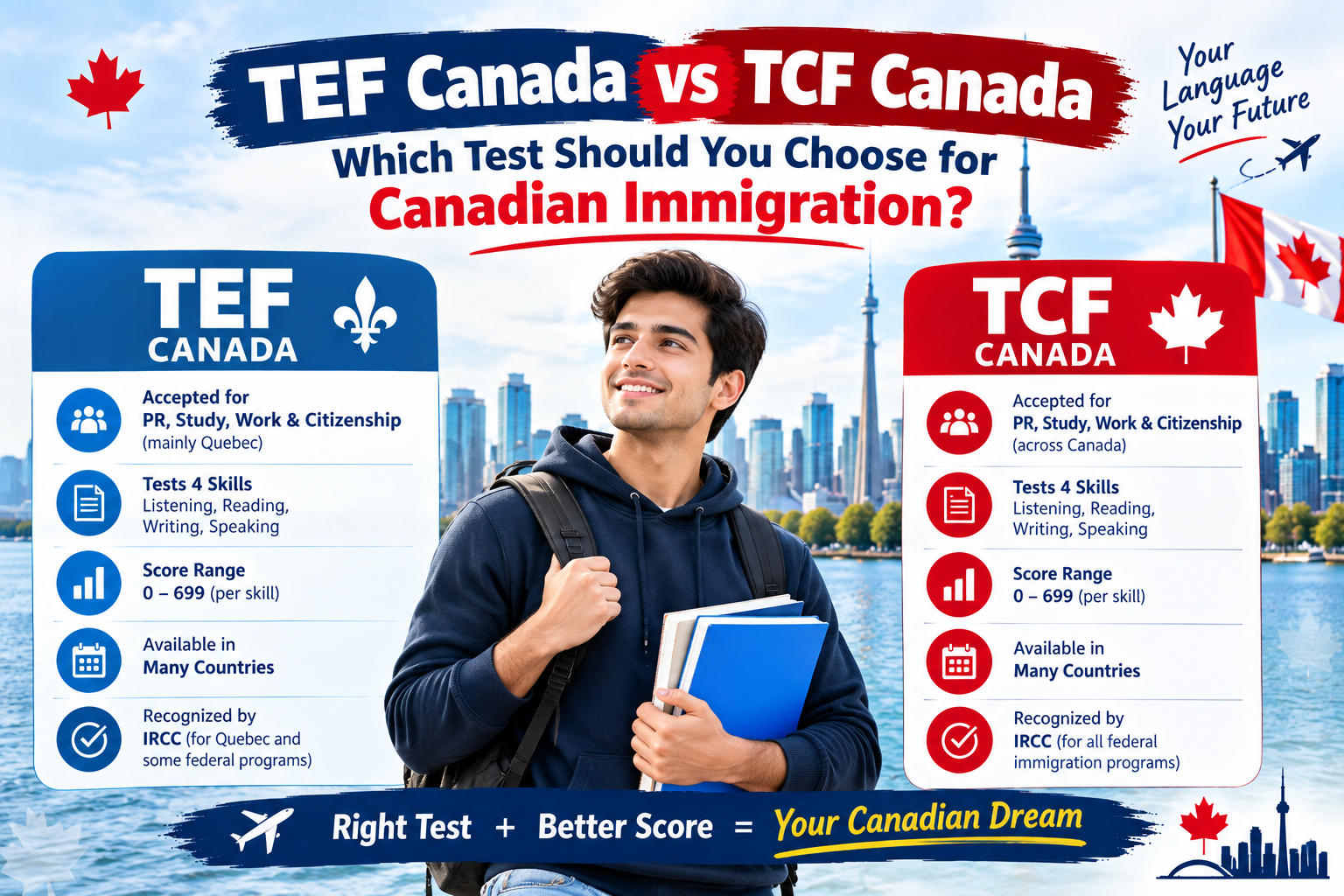
If you are planning to immigrate to Canada and want to use your French-language skills to support your immigration application, one important question may arise: Should you take TEF Canada or TCF Canada?
Both TEF Canada (Test d’évaluation de français) and TCF Canada (Test de connaissance du français) are officially accepted by Immigration, Refugees and Citizenship Canada (IRCC) for Express Entry and other eligible Canadian immigration programs. Both tests assess the four essential French-language skills: listening, reading, writing and speaking. IRCC converts results from both tests into NCLC (Niveaux de compétence linguistique canadiens) levels for immigration purposes.
However, the two exams have different formats, task structures and scoring systems. Understanding these differences can help you choose the test that better matches your learning style and language strengths.
At LearnFLE.fr, students preparing for Canadian immigration can build their French skills through structured preparation, regular practice and targeted training for the four language abilities required in TEF Canada and TCF Canada.
What Is TEF Canada?
TEF Canada is the Canadian immigration version of the Test d’évaluation de français. It is one of the French-language tests accepted by IRCC for Express Entry. The test is administered through the approved TEF testing system and evaluates a candidate’s ability to use French across the four core language skills.
The four skills assessed are:
- Compréhension orale – Listening
- Compréhension écrite – Reading
- Expression orale – Speaking
- Expression écrite – Writing
Your results in each ability are considered separately for Canadian immigration purposes. This means strong performance in one section does not automatically compensate for a lower result in another section when a particular immigration program requires a minimum NCLC level in all four abilities.
TEF Canada is therefore suitable for students who want focused preparation in French grammar, vocabulary, comprehension, speaking and written expression while becoming familiar with the specific test format.
What Is TCF Canada?
TCF Canada is another French-language proficiency test accepted by IRCC for Canadian immigration. Like TEF Canada, it evaluates the four core language skills required for immigration applications:
- Listening
- Reading
- Speaking
- Writing
TCF Canada results are also converted according to the Canadian NCLC framework. IRCC accepts TCF Canada alongside TEF Canada as proof of French-language ability for Express Entry. The minimum language level depends on the specific immigration program and the role French plays in the application. For example, requirements can differ between the Federal Skilled Worker Program, Canadian Experience Class and Federal Skilled Trades Program.
For many students, the choice between TEF Canada and TCF Canada is therefore not about which test is officially more valuable. Both are accepted by IRCC. The more useful question is: Which examination format is a better fit for your skills and preparation style?
TEF Canada vs TCF Canada: Key Differences
Although both exams assess French proficiency for Canadian immigration, there are important differences in their testing experience.
1. Test Format
TEF Canada and TCF Canada both assess the same four broad language abilities, but the structure of questions and tasks differs.
The format of the writing and speaking components is particularly important when choosing between the two exams. Some candidates may prefer a test with fewer, longer production tasks, while others may feel more comfortable completing multiple shorter tasks.
Because the task structure is different, students should practise with authentic-style exercises for the specific exam they plan to take. Preparing for general French alone may not be enough to become comfortable with time limits, instructions and task expectations.
2. Listening and Reading Approach
Listening and reading are essential components of both TEF Canada and TCF Canada.
Candidates need more than basic vocabulary. They must develop the ability to understand:
- Main ideas
- Specific information
- Opinions and attitudes
- Instructions
- Everyday conversations
- Formal and practical situations
- Written documents and messages
- Different vocabulary contexts
A structured preparation program should help students improve both their overall French comprehension and their ability to answer questions efficiently under examination conditions.
Regular listening practice is especially valuable because candidates may encounter different speeds, contexts and types of spoken French.
3. Writing Tasks
Writing can be challenging for candidates who have learned French mainly through speaking or informal conversation.
For Canadian immigration, candidates should develop skills such as:
- Organising ideas clearly
- Using appropriate grammar
- Choosing suitable vocabulary
- Writing according to the purpose of the task
- Connecting ideas logically
- Expressing and supporting opinions
- Managing time effectively
The writing formats in TEF Canada and TCF Canada differ, so students should understand the specific task requirements of their chosen test before the exam.
At LearnFLE.fr, targeted writing practice can help students identify common weaknesses in grammar, vocabulary, sentence structure and organisation.
4. Speaking Tasks
Speaking is another area where candidates should prepare specifically for the test format.
Good spoken French involves more than memorising answers. Candidates need to understand questions, respond naturally, organise their thoughts and communicate clearly.
Important speaking skills include:
- Introducing ideas
- Describing situations
- Asking questions
- Giving opinions
- Explaining choices
- Developing arguments
- Responding to another person’s viewpoint
- Using appropriate vocabulary
- Speaking with sufficient fluency
Regular speaking practice is particularly useful for students who understand French but do not frequently use it in conversation.
TEF Canada vs TCF Canada: Understanding NCLC Scores
For Canadian immigration, the final focus is generally not simply the name of the test. IRCC uses NCLC levels to assess French-language proficiency.
Both TEF Canada and TCF Canada have their own score-reporting systems, and IRCC provides official conversion information for determining the corresponding NCLC level. For Express Entry, candidates must ensure that they use and enter their scores according to IRCC’s current instructions. In particular, IRCC gives specific guidance on which TEF Canada score column should be used in an Express Entry profile.
This is why candidates should not compare a raw TEF score directly with a raw TCF score. The score scales differ. The meaningful comparison for Canadian immigration is how each result corresponds to the required NCLC level.
For example, the Federal Skilled Worker Program requires NCLC 7 in all four abilities when French is used as the first official language. Canadian Experience Class requirements depend on the applicant’s occupational category, while other programs have their own minimum thresholds.
Always check the current requirements of the specific immigration pathway you intend to use before booking your examination.
Is TEF Canada Easier Than TCF Canada?
There is no universal answer to this question.
One student may find TEF Canada more comfortable because of its format, while another may prefer TCF Canada. The difficulty can depend on several factors, including:
- Your current French level
- Your listening ability
- Your reading speed
- Your writing confidence
- Your speaking skills
- Your familiarity with the test format
- Your ability to work under time pressure
- Availability of preparation resources
- Availability of test sessions near you
Instead of asking only, “Which exam is easier?”, ask yourself:
Which exam format allows me to demonstrate my French skills more effectively?
The best way to answer this is to study the official format, try practice exercises and evaluate your performance across all four skills.
Which Test Should You Choose?
Consider TEF Canada If:
TEF Canada may be worth considering if you:
- Prefer its specific task structure
- Feel comfortable preparing for its style of writing and speaking tasks
- Have access to suitable TEF-focused preparation
- Find a convenient approved test date and location
- Perform well in TEF-style practice exercises
Consider TCF Canada If:
TCF Canada may be suitable if you:
- Prefer its particular examination format
- Feel more comfortable with its task structure
- Have access to suitable TCF-focused preparation
- Find a convenient test session at an approved centre
- Perform more confidently in TCF-style practice exercises
Since IRCC accepts both TEF Canada and TCF Canada, the practical choice should be based on your own preparation needs and the requirements of your immigration pathway.
The Importance of Choosing Your Target Score First
Before starting TEF Canada or TCF Canada preparation, identify the NCLC level you need for your intended immigration program.
This gives your learning a clear direction.
For example, a student targeting NCLC 7 should not simply study French randomly. The preparation plan should focus on reaching the required level in all four abilities.
A useful study plan may include:
- Daily vocabulary development
- Regular grammar revision
- Listening practice
- Reading practice
- Structured writing exercises
- Frequent speaking practice
- Timed mock exercises
- Error analysis
- Regular progress assessments
A score target also helps students understand how much preparation they may need before booking an examination.
How LearnFLE.fr Can Help You Prepare
Preparing for TEF Canada or TCF Canada requires consistent work across grammar, vocabulary, listening, reading, speaking and writing.
At LearnFLE.fr, a structured French-learning approach can help students progress through different levels of French while developing the practical skills needed for language proficiency examinations.
Preparation can focus on areas such as:
- French grammar foundations
- Essential and advanced vocabulary
- Listening comprehension
- Reading comprehension
- Speaking confidence
- Writing accuracy
- Exam-oriented strategies
- Timed practice
- Regular assessments
- Identification of weak areas
Students beginning at A1 may need to build a strong foundation before moving toward higher levels, while learners who already have intermediate French skills can focus more intensively on exam-specific practice.
The most effective preparation depends on your starting level, target NCLC score and available study time.
Final Thoughts: TEF Canada or TCF Canada?
TEF Canada and TCF Canada are both officially accepted French-language tests for Canadian immigration programs that accept these IRCC-approved results. Both evaluate listening, reading, speaking and writing, and both are assessed for immigration purposes through the Canadian NCLC framework.
The right choice depends primarily on the exam format that suits you, your individual language strengths, test-centre availability and your immigration requirements.
Before making a decision, review the official test information, check the current requirements for your Canadian immigration pathway and try practice material for the exam you are considering. Language-test results used for eligible immigration applications generally must be less than two years old at the relevant application stage, so candidates should also plan their test timing carefully.
Whether you choose TEF Canada or TCF Canada, success requires a strong command of French and balanced preparation in all four language skills.
With systematic learning, regular practice and exam-focused preparation, you can work toward your target NCLC level with greater confidence. LearnFLE.fr can support learners at different stages of their French journey, from building fundamental language skills to developing focused preparation strategies for TEF Canada and TCF Canada.