
Learning French is a valuable investment that can open doors to international education, global careers, immigration opportunities, and cultural experiences. However, once you begin learning the language, one of the most common questions is: Which French language certification should I choose?
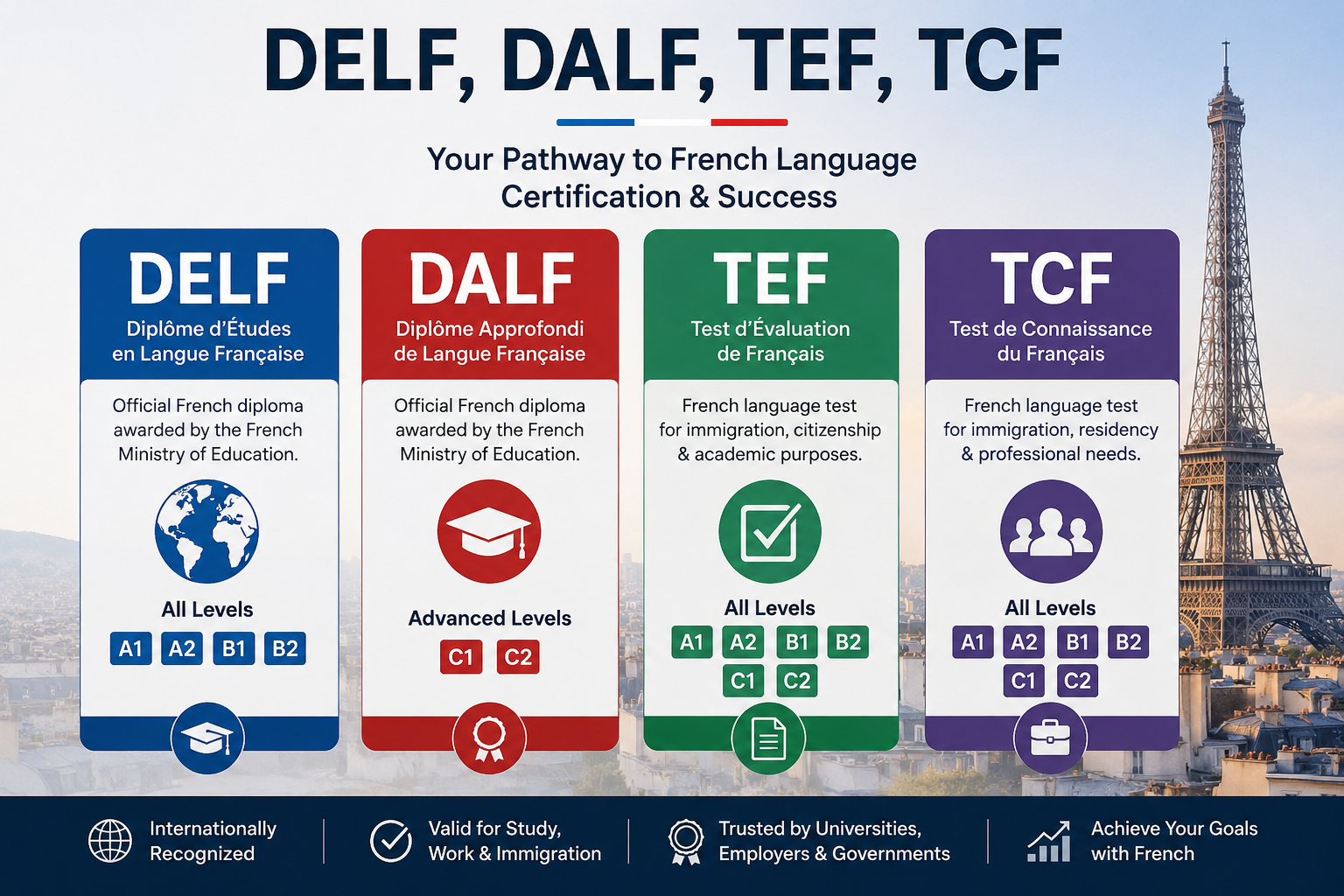
Among the most recognised French certifications are DELF, DALF, TEF, and TCF. While all of them assess French language proficiency, they serve different purposes and are designed for different audiences. Understanding their differences is essential before selecting the right exam.
At LearnFLE.fr, students receive expert guidance to choose the certification that aligns with their academic, professional, or immigration goals. This guide explains each certification, its purpose, format, and how to decide which one is right for you.
Why French Language Certifications Matter
An official French certification provides internationally recognised proof of your language skills. It can help you:
- Gain admission to French-speaking universities.
- Strengthen your CV for international employers.
- Meet language requirements for immigration programmes.
- Apply for scholarships.
- Improve career opportunities in multinational companies.
- Measure your progress using internationally recognised standards.
Most French language certifications are based on the Common European Framework of Reference for Languages (CEFR), which classifies proficiency into six levels: A1, A2, B1, B2, C1, and C2.
Understanding CEFR Levels
Before choosing a certification, it helps to understand the CEFR levels.
A1 – Beginner
You can understand and use simple everyday expressions and introduce yourself.
A2 – Elementary
You can communicate in routine situations and understand frequently used phrases.
B1 – Intermediate
You can manage everyday conversations and express opinions on familiar topics.
B2 – Upper Intermediate
You can communicate fluently in academic and professional settings.
C1 – Advanced
You can use French effectively in complex academic and workplace situations.
C2 – Mastery
You can understand and communicate almost like an educated native speaker.
DELF (Diplôme d’Études en Langue Française)
DELF is one of the most popular French language diplomas for non-native speakers. It is awarded by the French Ministry of Education and covers levels A1 to B2. It is internationally recognised and valid for life.
DELF Levels
- DELF A1
- DELF A2
- DELF B1
- DELF B2
Each level is independent, allowing candidates to register directly for the level that matches their proficiency.
Skills Tested
Every DELF examination assesses four essential language skills:
- Listening
- Reading
- Writing
- Speaking
Who Should Choose DELF?
DELF is ideal for:
- School students
- College students
- Beginners learning French
- Professionals seeking language certification
- Individuals planning to study abroad
Key Benefits
- Lifetime validity
- International recognition
- Accepted by universities and employers
- Structured according to CEFR standards
- Demonstrates practical communication skills
DALF (Diplôme Approfondi de Langue Française)
DALF is the advanced-level diploma for French learners. It is also awarded by the French Ministry of Education and is intended for learners at C1 and C2 levels. Like DELF, it is valid for life and recognised worldwide.
DALF Levels
- DALF C1
- DALF C2
Skills Evaluated
Candidates are tested on:
- Advanced listening comprehension
- Critical reading
- Academic and professional writing
- High-level spoken communication
Who Should Take DALF?
DALF is recommended for:
- University students
- Researchers
- Teachers
- Translators
- International professionals
- Individuals planning higher education in French-speaking countries
Advantages
- Highest level of French certification
- Recognised by universities worldwide
- Valuable for international careers
- Demonstrates advanced academic proficiency
TEF (Test d’Évaluation de Français)
Unlike DELF and DALF, TEF is not a diploma. It is a proficiency test that measures your current French level at the time of the exam. Results are generally valid for a limited period (commonly two years, depending on the version and intended use).
TEF is widely used for:
- Canadian immigration
- Employment
- University admissions
- Professional certification
- Language assessment
Different Versions
Several versions exist, including:
- TEF Canada
- TEF Québec
- TEF Études
- General TEF
Each version is designed for a specific purpose.
Exam Components
Depending on the version, candidates may complete:
- Listening
- Reading
- Writing
- Speaking
- Vocabulary and grammar
Who Should Choose TEF?
TEF is suitable for:
- Immigration applicants
- Working professionals
- Students applying abroad
- Individuals needing an official language assessment
TCF (Test de Connaissance du Français)
TCF is another official French proficiency test that measures your current level rather than awarding a permanent diploma. It is administered by France Éducation International and is also commonly valid for two years.
It is accepted for:
- University admissions
- Immigration
- Employment
- Personal assessment
Types of TCF
Different versions include:
- TCF Tout Public
- TCF Canada
- TCF Québec
- TCF IRN
Each serves different administrative or educational purposes.
Skills Tested
TCF generally assesses:
- Listening
- Reading
- Speaking
- Writing
- Language structures
DELF vs DALF
Although both are official diplomas, they target different proficiency levels.
| Feature | DELF | DALF |
| Levels | A1–B2 | C1–C2 |
| Difficulty | Beginner to Upper Intermediate | Advanced to Proficient |
| Validity | Lifetime | Lifetime |
| Issued By | French Ministry of Education | French Ministry of Education |
| Best For | Students and professionals | Advanced learners and academics |
TEF vs TCF
Both TEF and TCF assess your current level rather than awarding a permanent diploma.
They are commonly chosen for:
- Canadian immigration
- University applications
- Employment
- Official language assessment
While their formats differ slightly depending on the version, both are internationally recognised and aligned with the CEFR.
DELF vs TEF vs TCF: Which One Should You Choose?
The right certification depends on your objective.
Choose DELF if you want:
- A permanent qualification
- Internationally recognised certification
- Proof of language proficiency for studies or employment
Choose DALF if you:
- Already have advanced French
- Need high-level academic certification
- Plan postgraduate studies in French
Choose TEF if you:
- Are applying for Canadian immigration
- Need a current language proficiency assessment
- Require certification for employment or official procedures
Choose TCF if you:
- Need proof of your present French level
- Are applying to universities
- Need certification for immigration or administrative requirements
How LearnFLE.fr Helps You Prepare
Selecting the correct certification is only the first step. Proper preparation is equally important.
LearnFLE.fr provides structured coaching programmes designed to help learners succeed in DELF, DALF, TEF, and TCF examinations. The platform also offers specialised preparation for TEF and TCF Canada, with experienced trainers, mock tests, and flexible learning options.
Students benefit from:
Expert Trainers
Experienced French instructors explain grammar, vocabulary, pronunciation, and examination strategies in a structured manner.
Complete Exam Preparation
Courses include training for:
- Listening
- Reading
- Writing
- Speaking
Every section is covered according to the latest exam pattern.
Regular Mock Tests
Practice examinations help students:
- Improve time management
- Understand exam formats
- Build confidence
- Identify weak areas
Personalised Feedback
Individual performance reviews allow learners to improve steadily through targeted guidance.
Flexible Learning Options
Whether you prefer online classes or personalised coaching, LearnFLE.fr offers programmes suitable for school students, university applicants, professionals, and immigration candidates.
Tips for Choosing the Right Certification
Before registering for any French exam, ask yourself:
- Why do I need the certification?
- Am I applying for university admission?
- Do I need it for immigration?
- Is it for career advancement?
- What is my current CEFR level?
- Do I need a permanent diploma or a current proficiency test?
The answers will help you make the right decision.
Final Thoughts
French language certifications are valuable credentials that can support your educational, professional, and personal ambitions. While DELF and DALF are lifelong diplomas demonstrating achievement at specific CEFR levels, TEF and TCF are proficiency tests that assess your current language ability and are widely used for immigration, university admissions, and employment.
Choosing the right certification depends on your goals, current proficiency, and future plans. With expert guidance, structured lessons, comprehensive mock tests, and personalised support, LearnFLE.fr helps learners prepare confidently for every stage of their French language journey. Whether you are beginning with DELF A1, aiming for DALF C2, or preparing for TEF Canada or TCF Canada, the right preparation can make all the difference in achieving your desired results.