
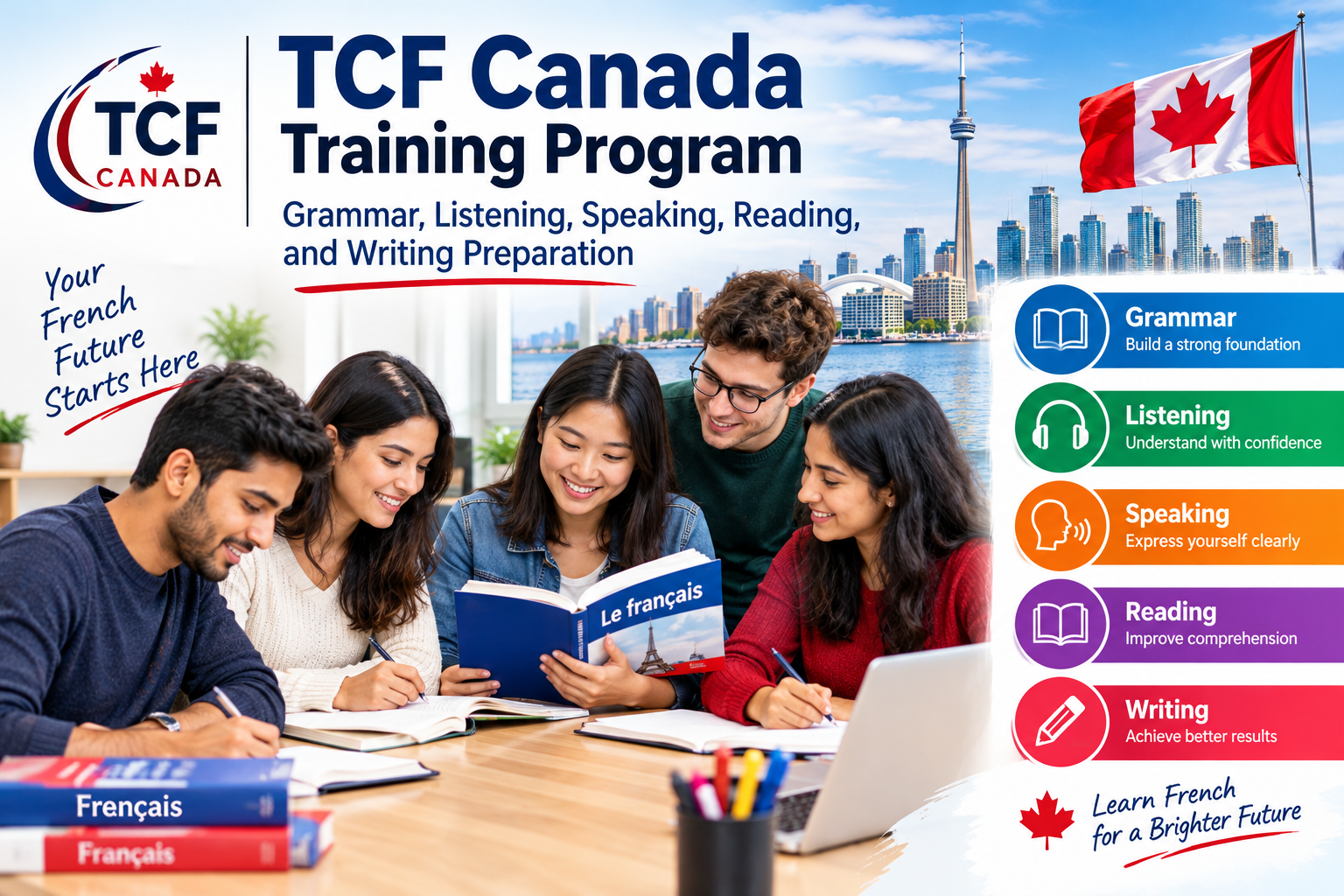
Learning French for Canadian immigration requires a structured approach, especially when preparing for the TCF Canada examination. Candidates need to develop multiple language skills and become familiar with the types of tasks, timing, and communication abilities assessed by the test. Simply memorizing vocabulary or studying grammar rules is not enough; effective preparation involves regular practice in listening, reading, speaking, and writing, supported by a strong foundation in French grammar and vocabulary.
At LearnFLE.fr, the 4-Month+ Intensive TCF Canada Program is designed for learners who want a structured pathway toward TCF Canada preparation. The program follows an accelerated progression from A1 → A2 → B1/B2 → TCF Canada Preparation, combining live instruction with guided self-study and practice.
The program includes 120 hours of live instruction and 170 hours of guided self-study and practice, representing a stated 290-hour total learning commitment. Classes are structured around three sessions per week of two hours each, alongside independent practice and assignments.
Whether you are beginning French from A1 or already have some knowledge of the language, a systematic training program can help you organize your preparation and work toward your individual language goals.
Understanding the TCF Canada Examination
The TCF Canada (Test de connaissance du français) is a French-language proficiency test used for certain Canadian immigration and citizenship purposes. It assesses French-language abilities through designated components.
Candidates should always check the latest official Canadian requirements and the current TCF Canada test specifications before planning their immigration application, because required scores and eligibility conditions can depend on the immigration program and may change over time.
For preparation purposes, learners generally need to develop four core language abilities:
- Listening comprehension
- Reading comprehension
- Speaking
- Writing
Grammar and vocabulary support all four skills. A learner with a strong vocabulary but weak listening skills, for example, may still struggle with comprehension tasks. Similarly, good grammar knowledge needs to be combined with practical speaking and writing practice.
This is why comprehensive TCF Canada training can be useful.
1. Build a Strong Grammar Foundation
Grammar is one of the foundations of French communication. It helps learners construct sentences accurately and express ideas clearly.
A TCF Canada training program should progressively introduce grammar concepts according to the learner’s level.
Important areas can include:
- French articles and gender
- Subject and object pronouns
- Verb conjugation
- Present, past, and future tenses
- Negation
- Questions
- Adjectives and agreement
- Prepositions
- Sentence structure
- Connectors and linking expressions
- More advanced grammatical constructions
For beginners, the focus should first be on understanding basic sentence patterns. As learners progress toward intermediate levels, they can begin using more complex structures.
At LearnFLE.fr, grammar development forms part of the structured progression from A1 through A2 and B1/B2 before moving into focused TCF Canada preparation.
The objective is not simply to memorize grammar rules. Students should learn how to apply those rules while speaking, writing, reading, and listening.
2. Expand French Vocabulary
Vocabulary development works alongside grammar. A broader vocabulary allows learners to understand more information and communicate ideas more effectively.
For TCF Canada preparation, students can build vocabulary around everyday and general communication topics such as:
- Family and relationships
- Education
- Employment
- Travel
- Housing
- Shopping
- Health and daily life
- Technology
- Environment
- Society
- Culture
- Professional situations
Instead of memorizing isolated words, students can learn words in context and practice using them in sentences.
For example, when learning employment-related vocabulary, students can practice describing their job, professional experience, responsibilities, and career plans.
Regular vocabulary revision is particularly important in an intensive course. Learners can maintain a personal vocabulary list, create example sentences, and revisit previously studied words.
3. Improve Listening Comprehension
Listening is an important part of French-language proficiency. Learners preparing for TCF Canada need to become comfortable understanding spoken French in different contexts.
Listening can be challenging because spoken French may sound different from written French. Speakers may also use different speeds, accents, expressions, and pronunciation patterns.
A structured training program can help learners gradually improve their listening ability.
Effective listening preparation includes:
Regular exposure: Listen to French consistently rather than only during classes.
Key-information practice: Learn to identify the main topic, important details, numbers, places, and opinions.
Context awareness: Use surrounding information to understand unfamiliar vocabulary.
Repeated practice: Review difficult audio and identify why comprehension was challenging.
Timed exercises: Practice responding within the relevant examination time constraints.
Students should also avoid trying to translate every French word into their first language. Instead, they can gradually develop the ability to understand meaning directly from French.
LearnFLE.fr incorporates listening practice into its broader French language and TCF Canada preparation approach.
4. Develop Reading Comprehension
Reading comprehension requires learners to understand written information quickly and accurately.
Students preparing for TCF Canada can practice with different types of French texts, including:
- Short messages
- Emails
- Notices
- Advertisements
- Everyday information
- Articles
- Descriptions
- Opinions
- Longer passages
A useful reading strategy is to identify the purpose and main idea of a text before focusing on individual details.
Students should also develop the ability to recognize synonyms and understand words based on context.
Reading preparation tips
- Read French material regularly.
- Highlight unfamiliar vocabulary.
- Practice identifying the main idea.
- Search for specific information within a passage.
- Complete timed comprehension exercises.
- Review incorrect answers.
- Re-read difficult texts to understand the reasoning behind answers.
As learners move from A1 to A2 and eventually B1/B2, reading materials can gradually become more complex.
This progressive approach can help students develop reading confidence before beginning intensive examination preparation.
5. Strengthen Speaking Skills
Speaking practice is essential for learners who want to communicate confidently in French and prepare for the oral component of TCF Canada.
Many learners understand grammar but hesitate when speaking. They may know what they want to say but struggle to find the right vocabulary or construct sentences quickly.
Regular guided speaking practice can help address these challenges.
Students can practice:
- Introducing themselves
- Asking questions
- Answering questions
- Describing situations
- Expressing opinions
- Making suggestions
- Explaining ideas
- Discussing everyday topics
- Developing longer responses
An instructor can provide feedback on pronunciation, vocabulary, grammar, sentence structure, and clarity.
How to Practice Speaking at Home
Students can create short daily speaking exercises.
For example, choose a topic and speak about it in French for several minutes. Topics could include your daily routine, education, work, hobbies, travel, technology, or future plans.
Recording yourself can also help identify repeated pronunciation or grammar problems.
The objective should be clear communication and gradual improvement rather than trying to speak perfectly from the beginning.
6. Improve French Writing
Writing preparation requires attention to grammar, vocabulary, organization, and the requirements of the particular task.
Students should practice expressing ideas clearly and structuring their responses logically.
Writing preparation can include:
- Sentence construction
- Paragraph organization
- Vocabulary development
- Verb conjugation
- Grammar correction
- Linking words
- Appropriate expressions
- Spelling
- Task-specific writing practice
At LearnFLE.fr, writing practice and correction are incorporated into the intensive learning approach.
A practical writing routine
Start with short sentences and paragraphs. Gradually progress toward longer responses.
After completing a writing exercise, review it carefully:
- Did I answer the task?
- Are my ideas organized?
- Did I use suitable vocabulary?
- Are my verb tenses correct?
- Are my sentences clear?
- Did I make repeated grammar mistakes?
Teacher feedback can help learners identify patterns and work on areas that need improvement.
7. Follow the A1 → A2 → B1/B2 → TCF Pathway
One of the central features of the LearnFLE.fr intensive program is its progressive pathway:
A1 → A2 → B1/B2 → TCF Canada Preparation
This structure can be useful for students who need to develop their French foundation before concentrating heavily on exam-oriented activities.
A1: Foundation
Students develop basic vocabulary, pronunciation, grammar, and everyday communication.
A2: Elementary Communication
Learners expand vocabulary, understand more everyday conversations, and develop greater control of basic French structures.
B1: Intermediate Development
Students work on independent communication, expressing opinions, describing experiences, and understanding increasingly complex language.
B2: Upper-Intermediate Development
Learners work toward more detailed communication, broader vocabulary, complex structures, and improved fluency.
TCF Canada Preparation
Once appropriate language foundations have been developed, learners can focus more specifically on examination-related tasks, timing, strategies, and practice.
Progress varies between learners. Course duration should therefore be viewed as a structured learning framework rather than a guarantee of achieving a specific proficiency level or TCF Canada score.
8. Learn With Live Instruction and Guided Self-Study
The LearnFLE.fr 4-Month+ Intensive TCF Canada Program combines live instruction with guided independent learning.
The program includes:
120 hours of live instruction
Students participate in structured lessons and language activities.
170 hours of guided self-study and practice
Learners receive additional opportunities to revise concepts, complete assignments, and practice language skills.
290 hours total commitment
The stated total combines live instruction and guided self-study.
Three classes per week × two hours
This provides a defined weekly learning schedule.
This combination can be particularly useful for learners who want regular guidance while also having dedicated time for independent practice.
Students should plan their schedules carefully to make sufficient time for both live classes and self-study.
9. Practice TCF-Style Tasks and Exam Strategies
Language learning and examination preparation should work together.
Students should become familiar with the relevant TCF Canada task formats, instructions, timing, and examination expectations.
LearnFLE.fr’s intensive program includes TCF-style exercises and exam-oriented preparation.
Important preparation areas include:
- Understanding task instructions
- Managing time
- Practicing under realistic conditions
- Reviewing errors
- Developing speaking responses
- Improving writing accuracy
- Building listening speed
- Increasing reading efficiency
Students should use official TCF Canada information to confirm the current examination structure applicable to them.
10. Use Regular Assessments to Track Progress
Regular assessments can help learners understand their development.
A structured program can evaluate different areas, including:
| Skill | What Students Can Monitor |
| Grammar | Sentence accuracy and grammatical structures |
| Vocabulary | Retention and contextual usage |
| Listening | Understanding spoken French |
| Reading | Comprehension and efficiency |
| Speaking | Fluency, pronunciation, and clarity |
| Writing | Organization, grammar, and vocabulary |
Assessment results can help students identify which skills need additional practice.
For example, a learner may discover that their reading skills are developing faster than their speaking ability. They can then dedicate additional study time to oral practice.
Assessments can support progress tracking, but they should not be treated as guarantees of an official TCF Canada result.
11. Create a Consistent Study Routine
An intensive course works best when students maintain regular study habits.
A practical weekly routine can include:
Live Classes: Attend all scheduled lessons.
Grammar Review: Revise concepts covered during the week.
Vocabulary: Learn and review new words.
Listening: Complete French listening exercises.
Reading: Read French texts and practice comprehension.
Speaking: Practice French conversations and responses.
Writing: Complete writing activities and review corrections.
Consistency is often more sustainable than attempting to complete large amounts of study at irregular intervals.
12. Who Can Benefit From TCF Canada Training?
The LearnFLE.fr TCF Canada training pathway may be relevant to:
Beginners
Learners who want to start French from A1 and progressively develop their language skills.
Immigration Candidates
Individuals preparing French-language proficiency for an eligible Canadian immigration pathway.
Working Professionals
Professionals who need a structured program that combines scheduled classes with independent study.
Existing French Learners
Students who already know French and want to strengthen their language abilities and transition toward TCF-focused preparation.
Before enrolling, learners should consider their current level, target timeline, available study hours, and the requirements of their intended Canadian immigration pathway.
Why Choose LearnFLE.fr for TCF Canada Preparation?
LearnFLE.fr’s 4-Month+ Intensive TCF Canada Program provides a structured pathway combining language development and examination preparation.
Key program features include:
- A1 → A2 → B1/B2 → TCF Canada Preparation
- 120 hours of live instruction
- 170 hours of guided self-study and practice
- 290 hours total learning commitment
- Three classes per week
- Two hours per class
- Grammar and vocabulary development
- Listening comprehension practice
- Reading comprehension practice
- Speaking activities
- Writing practice and correction
- TCF-style exercises
- Exam task formats and timing
- Regular assessments and assignments
This comprehensive approach is designed to give learners a clear framework for developing French language skills while progressing toward TCF Canada preparation.
Conclusion
A successful TCF Canada preparation journey requires consistent practice across grammar, vocabulary, listening, reading, speaking, and writing. Candidates also need to understand the examination format and develop effective time-management and test-taking strategies.
The LearnFLE.fr 4-Month+ Intensive TCF Canada Program offers a structured learning pathway from A1 to A2 and B1/B2, followed by focused TCF Canada preparation. With 120 hours of live instruction, 170 hours of guided self-study, regular assessments, and practice across the four core language skills, the program provides a framework for learners who want to approach French learning systematically.
Whether you are starting French from the beginning or strengthening existing skills for Canadian immigration purposes, consistent learning and targeted practice can help you work toward your personal language objectives.
Explore the TCF Canada Training Program at LearnFLE.fr and begin your structured French language preparation for your Canadian immigration goals.
Suggested SEO Keywords
- TCF Canada Training Program
- TCF Canada Exam Preparation Course Online
- TCF Canada French Coaching
- TCF Canada Preparation Course
- TCF Canada Classes Online
- TCF Canada French Course for Immigration
- French Classes for Canadian Immigration
- TCF Canada Listening Speaking Reading Writing
- TCF Canada Grammar and Vocabulary
- 4-Month+ Intensive TCF Canada Program
- LearnFLE TCF Canada Preparation
- TCF Canada Training Institute