
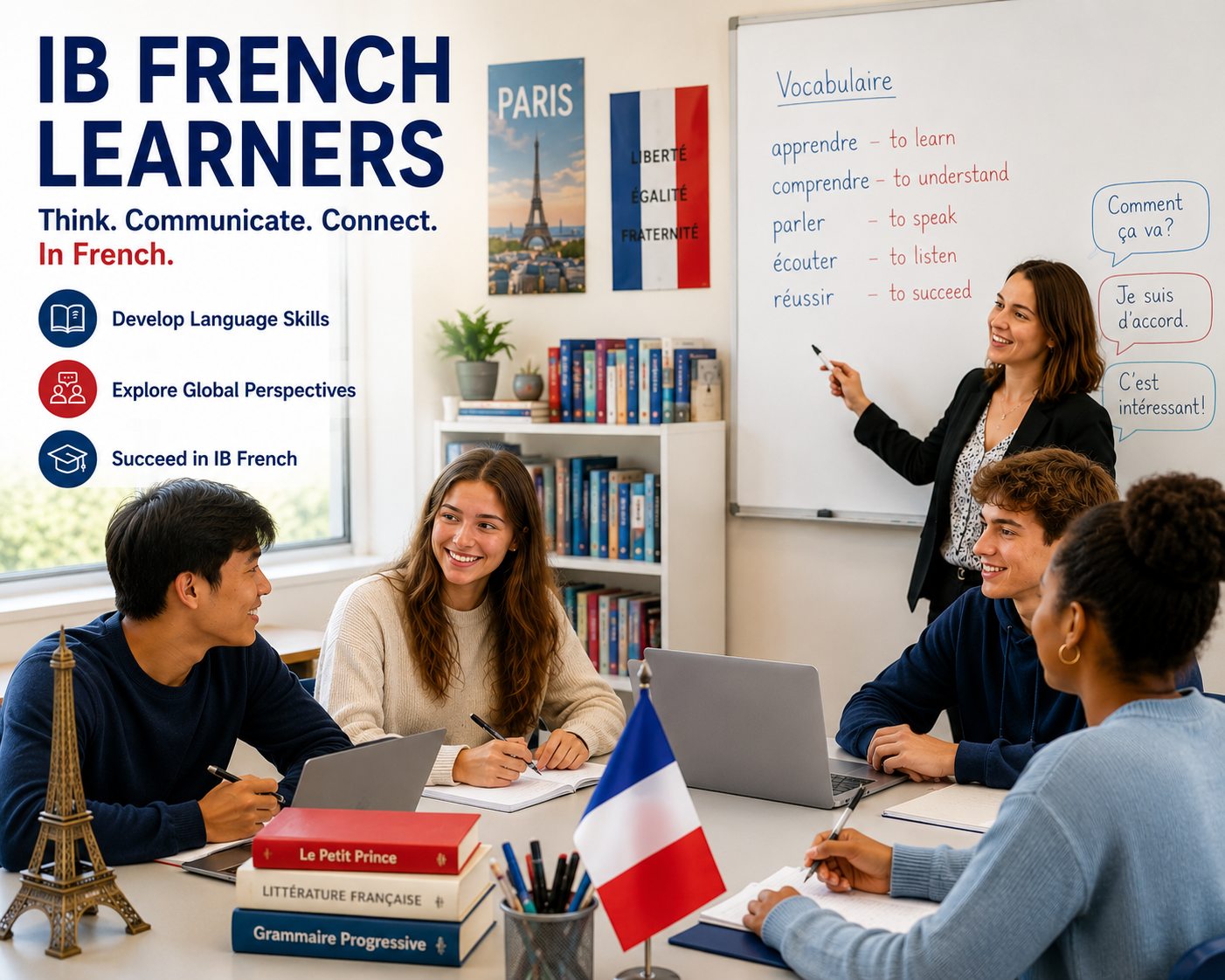
The International Baccalaureate (IB) French program is designed to develop students’ communication skills, cultural awareness, critical thinking, and language proficiency. Whether students are enrolled in IB French Ab Initio, Standard Level (SL), or Higher Level (HL), they often discover that the course is far more demanding than traditional school language programs.
IB French requires learners to master reading, writing, listening, and speaking while applying advanced grammar and analytical skills. Many students struggle to balance these requirements alongside the rigorous demands of other IB subjects.
The good news is that most challenges faced by IB French learners are common and can be overcome with the right strategies and guidance. In this article, we explore the most frequent difficulties experienced by IB French students and provide practical solutions to help them achieve better results.
1. Difficulty with French Grammar
One of the biggest challenges for IB French learners is mastering French grammar. Students are expected to use a variety of grammatical structures accurately in both speaking and writing tasks.
Common grammar difficulties include:
- Verb conjugations
- Past, present, and future tenses
- Gender agreements
- Pronouns
- Subjunctive mood
- Complex sentence structures
French grammar often feels overwhelming because many rules differ significantly from English grammar. Learners frequently struggle with gender agreement and verb forms, which are common challenges in French language acquisition.
Solution
Instead of memorizing grammar rules in isolation:
- Practice grammar through real sentences.
- Create grammar summary notes.
- Focus on one grammar topic each week.
- Write short paragraphs using new structures.
- Review corrections regularly.
Consistent practice is more effective than trying to learn multiple grammar concepts at once.
2. Lack of Speaking Confidence
Many IB French students understand the language well but hesitate to speak during class discussions or oral assessments.
Students often experience:
- Fear of making mistakes
- Difficulty finding words quickly
- Nervousness during presentations
- Limited fluency
Research and learner experiences consistently show that confidence and anxiety are major barriers to effective communication in French.
Solution
To improve speaking confidence:
- Practice speaking daily, even for 10 minutes.
- Record yourself answering IB-style questions.
- Participate in French conversations regularly.
- Focus on communication rather than perfection.
- Learn topic-specific vocabulary for common IB themes.
Students who engage in frequent speaking practice typically become more comfortable expressing ideas spontaneously.
3. Listening Comprehension Challenges
Listening is often considered one of the most difficult parts of IB French.
Students frequently struggle because:
- Native speakers talk quickly.
- Words blend together through liaisons.
- Accents vary across French-speaking regions.
- Real-life French differs from textbook French.
Many learners report that they understand written French but find spoken French much harder due to speed and pronunciation patterns.
Solution
Improve listening skills by:
- Listening to French podcasts daily.
- Watching French videos with subtitles.
- Practicing IB listening exercises regularly.
- Listening to short clips multiple times.
- Taking notes while listening.
Consistency is key. Even 15 minutes of daily listening practice can significantly improve comprehension over time.
4. Limited Vocabulary
Vocabulary development is essential for success in IB French.
Students often encounter difficulties when:
- Writing essays
- Participating in oral assessments
- Understanding authentic texts
- Expressing complex opinions
A limited vocabulary can prevent students from demonstrating their true language abilities.
Solution
Build vocabulary systematically by:
- Learning words by theme.
- Creating flashcards.
- Keeping a vocabulary journal.
- Using new words in speaking and writing.
- Reviewing vocabulary regularly.
Focus on IB themes such as:
- Identities
- Human ingenuity
- Social organization
- Experiences
- Sharing the planet
Topic-based vocabulary learning is far more effective than memorizing random word lists.
5. Weak Writing Skills
Many students lose marks in IB French because of poor organization rather than language mistakes.
Common writing issues include:
- Weak structure
- Repetitive ideas
- Limited arguments
- Lack of coherence
- Poor use of connectors
IB examiners assess communication, organization, and idea development in addition to language accuracy. Students who focus only on vocabulary often miss important scoring opportunities.
Solution
Improve writing performance by:
- Planning before writing.
- Using clear introductions and conclusions.
- Practicing different text types.
- Learning transition phrases.
- Reviewing model answers.
Students should focus on expressing ideas clearly rather than trying to use unnecessarily complicated language.
6. Difficulty Understanding Assessment Criteria
Many IB French learners work hard but fail to achieve their target grades because they do not fully understand how assessments are marked.
Students often assume that:
- More vocabulary automatically means higher marks.
- Longer answers receive better scores.
- Memorization guarantees success.
However, IB assessments evaluate communication, organization, interaction, and idea development alongside language accuracy.
Solution
Students should:
- Review marking criteria regularly.
- Analyze examiner expectations.
- Study sample high-scoring responses.
- Practice under exam conditions.
- Seek feedback from experienced teachers.
Understanding what examiners are looking for can dramatically improve performance.
7. Managing Time Effectively
IB students often study six subjects simultaneously while completing Internal Assessments, Extended Essays, and CAS requirements.
As a result, many learners struggle to dedicate sufficient time to French practice.
Solution
Create a structured study plan:
- Allocate specific French study sessions each week.
- Alternate between listening, reading, writing, and speaking.
- Use short but consistent study periods.
- Prioritize weaker skills.
Even 20–30 minutes of focused daily practice can produce significant improvements.
8. Exam Anxiety
Many capable students underperform because they become anxious during exams and oral assessments.
Symptoms include:
- Forgetting vocabulary
- Speaking too quickly
- Losing concentration
- Making avoidable mistakes
Exam anxiety is particularly common during the Individual Oral assessment.
Solution
Reduce anxiety by:
- Taking mock exams regularly.
- Practicing oral presentations.
- Developing relaxation techniques.
- Becoming familiar with exam formats.
- Building confidence through preparation.
The more students practice under realistic conditions, the more comfortable they become during actual assessments.
How LearnFLE.fr Helps IB French Students Succeed
At LearnFLE.fr, we understand the unique challenges faced by IB French learners. Our specialized coaching programs focus on:
- Grammar mastery
- Speaking confidence
- Listening improvement
- Writing excellence
- Vocabulary development
- Exam preparation
- Oral assessment practice
Our experienced French instructors provide personalized guidance tailored to each student’s strengths and areas for improvement. Through structured lessons, regular feedback, and targeted exam strategies, students develop the skills and confidence needed to excel in IB French.
Conclusion
IB French is undoubtedly challenging, but the obstacles students face are not impossible to overcome. Grammar difficulties, speaking anxiety, listening comprehension problems, limited vocabulary, and exam pressure are all common experiences among learners.
The key to success lies in consistent practice, strategic preparation, and understanding how IB assessments are evaluated. By addressing these challenges systematically and seeking expert guidance when needed, students can significantly improve their performance and achieve their desired IB French scores.
With dedication, effective study habits, and the right support from LearnFLE.fr, every IB French learner can transform challenges into opportunities for growth and success.